
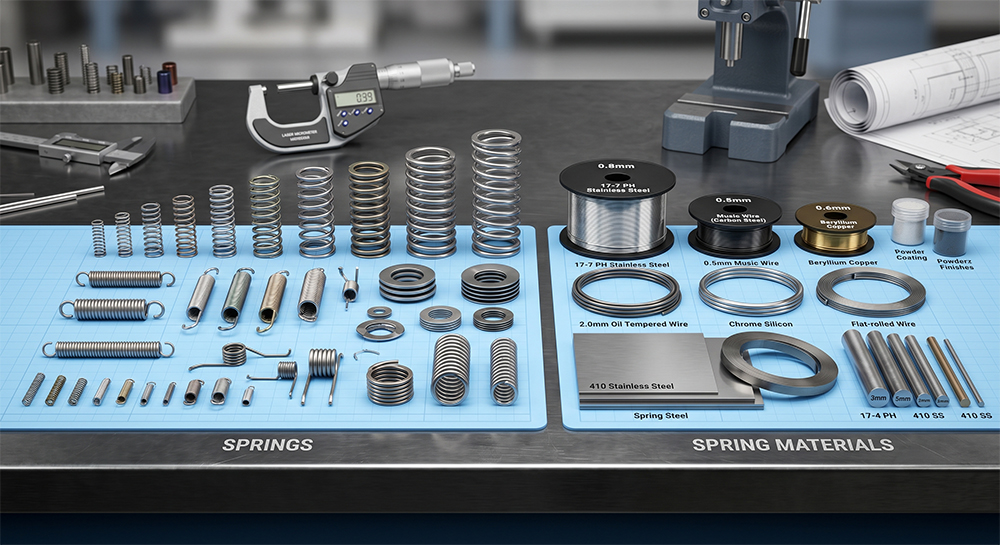
 Selecting the right material is the most critical decision in spring design. This guide combines environmental considerations with technical engineering data to help both new customers and seasoned engineers select the optimal material for their application at Murphy & Read Spring Manufacturing, Co.
1. Identifying Your Environment
Before analyzing mechanical loads, identify the environmental stressors the spring must endure:
- Temperature: Operating temperatures affect the material’s elastic modulus and load-carrying ability.
- Corrosion: Exposure to moisture, salt, or chemicals requires specific protective alloys or coatings.
- Conductivity/Magnetism: Determine if the spring must be non-magnetic or electrically conductive.
2. Mechanical & Material Property Matrix
This table provides a high-level comparison of the materials available at Murphy & Read, including critical engineering constants.
| Material Class | Specific Materials | Max Temp (°F) | Modulus (G x 106 psi) |
|---|---|---|---|
| High Carbon Steel | Music Wire, Hard Drawn, Oil Temper | 250° | 11.5 |
| Alloy Steel | Chrome Vanadium, Chrome Silicon | 425° – 475° | 11.5 |
| Stainless Steel | 302, 316, 17-7PH | 500° – 600° | 10.0 – 11.0 |
| Copper Alloys | Phos Bronze, BeCu, Brass | 200° – 400° | 6.25 – 7.5 |
| Superalloys | Inconel, Hasteloy, Monel, Elgiloy | Up to 1100° | 11.0 – 11.2 |
3. Critical Engineering Considerations
Stress Relaxation & Fatigue
- Stress Relaxation: For springs held at a constant load, higher temperatures lead to “set.” Use Chrome Silicon or Inconel for high-temperature stability.
- Fatigue Life: For designs with a wire diameter less than 0.080”, music wire is the best choice for high stress and high cycle applications. For larger wire diameters, alloys such as Chrome Silicon are superior.
- Shot Peening: This secondary process adds compressive stress to the surface, significantly increasing the fatigue limit for any material.
Modulus Variation for Rate Calculations
The spring rate is directly proportional to the Shear Modulus (G). Note that Phosphor Bronze and Beryllium Copper have much lower moduli than steel, allowing for more deflection with less force in precision applications.
Specialty Materials & Finishes
- Ni Span: Features a constant modulus of elasticity across temperature ranges, essential for precision instruments.
- Copper Clad: Steel core for strength with a copper exterior for high electrical conductivity.
- Pre-Coat: Wire pre-treated with zinc or other barriers to provide corrosion resistance without the hydrogen embrittlement risks of post-winding plating.
4. Summary of Common Materials
- Music Wire: The “Gold Standard” for high strength and fatigue in small diameters.
- Chrome Silicon: Best for high-stress applications and shock loading.
- 17-7PH Stainless: Best for high-strength requirements in corrosive environments.
- Inconel X-750: The go-to for extreme heat and chemical resistance.
Selecting the right spring material helps ensure spring performance and longevity. Please Contact us to speak with an engineer about what material is best for your application.