
Murphy & Read manufactures standard and custom compression springs that adhere to our customer’s tight tolerances and specifications. We offer state of the art manufacturing for high volume custom production (.005”-.250” wire), or short run and prototypes (.005”-1.75” wire). Our advanced manufacturing capabilities allow us to produce compression springs to your exact specifications, including custom materials, specialized end treatments, surface finishes and precise tolerances.
We produce millions of custom springs each year for leading companies around the globe. Our customers are found in fields such as Medical, Hardware, Automotive, Household Tools and Appliances, Aerospace, Valves, Computer Peripherals, Electric Controls and Assemblies, Firearms, Optics, and all branches of the Military & OEM.
We offer an extensive list of standard springs ranging in size from a wire diameter of .006-.225, an Outside diameter of .063-2.00 and Free Length From .093”-7.00”. If you are unable to find one of our stock items that matches your needs, we can make virtually any custom spring you need. If you need technical help, we have a responsive and experienced staff of engineers.
Buy Springs

What is a compression spring?
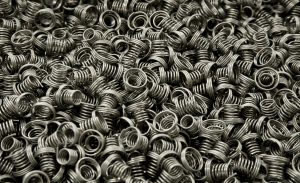
- Functionality and Applications: Compression springs are essential mechanical components engineered to resist compressive forces. They store energy when compressed and release it when the force is removed, providing controlled pressure or return forces. They are widely used in applications ranging from simple push buttons and automotive suspensions to complex machinery and medical devices. Other common uses include: valve mechanisms, electrical contacts, shock absorption, product ejectors and battery contacts.
- Material Selection and Performance: Compression springs can be manufactured from various materials to meet specific requirements, including stainless steel for corrosion resistance, music wire for high strength, and exotic alloys for extreme temperatures or environments. The choice of material directly impacts the spring’s performance, durability, and operating life.
Specific Applications
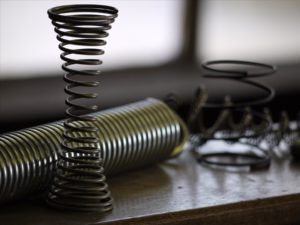 Compression springs are incredibly versatile components, and their applications span a vast range of industries. Essentially, compression springs resist force applied to them, storing energy when compressed and releasing it when expanded. Murphy & Read specializes in precision, tight tolerance applications. Below are examples of how compression springs are used in some of the sectors we work with frequently:
- Medical: Used in medical devices like syringes (for controlled injections), surgical instruments, and diagnostic equipment. They provide precise and reliable force in critical applications.
- Hardware: Found in various hardware items, such as push-button mechanisms, door latches, and mechanical fasteners. They provide the necessary force for these devices to function correctly.
- Automotive: Crucial in vehicle suspension systems (absorbing shocks), clutch mechanisms, and engine valves. They contribute to a smooth ride and proper engine function.
- Household Tools and Appliances: Used in tools like spring-loaded clamps and in appliances like washing machines (suspension) and lawnmowers. They provide necessary tension and shock absorption.
- Aerospace: Used in aircraft landing gear, control systems, and various mechanical assemblies. They must withstand extreme conditions and provide reliable performance.
- Valves: Essential in controlling fluid flow in various systems. They provide the force needed to open and close valves, ensuring precise control.
- Computer Peripherals: Used in keyboards (providing tactile feedback), printers (paper feed mechanisms), and other peripherals. They contribute to the smooth operation of these devices.
- Electric Controls and Assemblies: Used in switches, relays, and circuit breakers. They provide the necessary force for electrical contact and switching.
- Military: Military applications are very broad, including use in weaponry, vehicles, and communication equipment, requiring high reliability.
Interactive CAD Spring Configurator
Need a CAD drawing? Try our free CAD configurator tool to produce standard or custom spring models.
Spring Materials
We use a range of spring materials to meet the needs of our diverse customer base. Here are the materials we use most often and their maximum recommended % tensile:
| Material | Recommended Tensile Strength (%) |
|---|---|
| Music Wire | 45% |
| 316 Stainless Steel | 35% |
| 17-7 Stainless Steel | 45% |
| 302 Stainless Steel | 35% |
| Chrome Silicon | 45% |
| Chrome Vanadium | 45% |
Resources
Comprehensive Technical Resources
Our technical resources section is a valuable repository of information on compression spring engineering, materials, and applications. You’ll find:
- Spring calculators and formulas
- Material selection guides
- Glossary of spring terminology
- Application-specific case studies
- CAD files of common spring types.
- White papers and articles on advanced spring technologies.
Engineering Support
Our team of experienced spring engineers is available to provide expert technical assistance. Whether you need help selecting the right material, calculating spring rates, or optimizing your springs for performance and cost-effectiveness, we’re here to help. We offer:
- Technical consultations
- Prototyping services
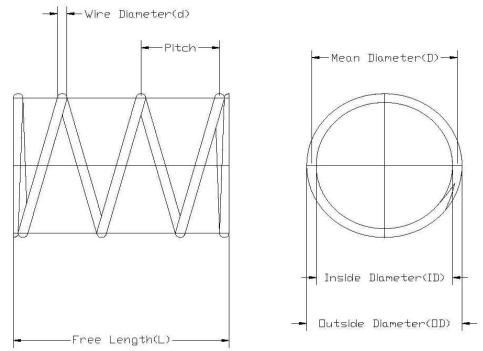
Spring Terminology
| Abbreviation | Meaning |
|---|---|
| OD | Outside Diameter |
| D | Mean Diameter |
| d | Wire Diameter |
| Na | Number of Active Coils |
| Nt | Number of Total Coils |
| R | Spring Rate |
| P | Applied Force |
| S | Wire Stress |
| c | Spring Index |
| ΔL | Deflection |
| FEG | Ends Flat and Ground |
| FE | Ends Flat not Ground |
| PEG | Ends Plane and Ground |
| PE | Ends Plane not Ground |
| UTS | Ultimate Tensile Strength |
Compression Springs FAQ: Selection & Ordering
Which type of spring do I need?
Choose a compression spring for a pushing or return force, an extension spring for a pulling force, or a torsion spring for rotational force. If the part is a shaped clip, hook, or frame, a custom wire form may be the better fit.
Should I buy a stock spring or request a custom design?
Start with a stock spring if its dimensions and performance meet your requirements. Request a custom spring when fit, load, material, end treatment, or tolerance needs differ. Many applications require a custom solution.
What measurements should I use to find a stock compression spring?
Start with the available outside diameter, then check wire diameter, free length, and the required force at your installed length. Use the filters next to the spring table above to narrow results by these dimensions.
How do I know what force a spring will produce when compressed?
Find its spring rate and subtract the installed length from its free length. Within the spring’s specified working range, force is approximately spring rate × deflection. Check the listed load and allowable travel as well. See Spring Terminology below for definitions of these terms.
What is solid height, and why does it matter?
Solid height is the spring’s length when its coils are fully compressed. Compare it with the shortest length your assembly reaches to ensure the spring has adequate working travel. End style also affects solid height. See Spring Terminology for more.
Will the spring fit over my shaft or inside a bore?
Check both inside and outside diameter, allowing room for manufacturing variation and burrs. Tell M & R Spring about close-fitting shafts, bores, or surrounding parts when requesting a custom spring.
Which end style and finish should I specify?
Common end styles include flat and ground, flat and unground, plane and ground, and plane and unground. Specify how the spring must seat and whether end squareness is critical. Custom end treatments and surface finishes are available – see our technical resources for reference.
How can I improve life in a high-cycle application?
Share your working loads, travel, cycle count, and operating frequency with the engineering team. Stress level, material selection, shot peening, presetting, and resonance can all affect compression spring life. Our technical resources cover these factors in more detail, or contact us directly.
Can I order a spring to a military specification?
M & R Spring offers MIL-spec compression springs manufactured to AS24585 and MS24585 standards. Provide the exact part number and any required material or documentation when requesting a quote.
Which spring material is best for moisture, heat, or repeated cycling?
Material depends on the environment and required force and life. M & R Spring offers music wire, stainless steels, alloy steels, copper alloys, and specialty materials. See our material selection guide, or share your operating conditions so an engineer can recommend a grade and any coating.
What should I send for a custom spring quote?
Send a drawing or sketch if available, quantity, spring type, material, key dimensions and tolerances, end details, finish, and required load at the working length or torque at the working angle. Include operating temperature and expected cycles when they affect performance. Request a quote to get started.
Can I order prototypes before committing to production?
Yes. M & R Spring supports short runs and prototypes as well as high-volume custom production. Ask for prototype and production quantities together when requesting a quote.
Can I get CAD models, testing records, or certifications?
M & R Spring provides a CAD spring configurator and is ISO 9001 certified. Certificates of conformance, dimensional and load-test records, and material certifications may be available at additional cost. Specify the documents you need in your quote request.